The MV Explorer spent time in Hong Kong and Shanghai but Semester at Sea voyagers went far beyond those two cities. The greatest number went to Beijing where the Great Wall seems to have been the main attraction as well as Tiananmen Square. SAS students also had the opportunity to meet and interact with students from a number of Chinese universities.
What many voyagers have told me were the best experiences though were not the big tourist attractions, but the more intimate moments where they were able to experience China on a deeper level. It’s possible that the most fun was had by a group of students who were guided through Hong Kong by our interport student, Edmond.
Andrew Davis, Tomas Ramos, and Eric Stephenson were walking through Edmond’s neighborhood when they stumbled onto familiar territory, a basketball court. Within a few minutes, they had started a pickup game and pretty soon, the whole neighborhood had gathered to watch them play. “They were amazed…and yelling like I was some sort of hero,” Andrew said. The students were hugged and signed autographs, making them feel like they were celebrities. “It was a blessing for me to be able to do that and enjoy their company,” Andrew told the community last night at post-port reflection when describing how he felt that day.
There are also a number of students on board who are of Asian descent, and for them, our time in Hong Kong and Shanghai took on a more personal meaning. Some were able to become reacquainted with family, others saw the places where their parents were born or spent a large part of their lives. For others that had lived in Asia themselves, “it felt like home.”
In addition to the events taking place on shore while the MV Explorer was docked in China though, there was something very special transpiring on board the ship. Semester at Sea announced the launch of a milestone program in its academic history, the C.Y. Tung Program in Sino-U.S. Relations.
In the words of Les McCabe, our Executive Dean and the president of the Institute for Shipboard Education, “This program marks a new era by offering a timely and integrated study of China – one of the world’s most influential global powers – and its relations with the United States. It will bring together students, scholars, and prominent figures to explore the history and cultures of China and the United States, and to consider how to ensure productive economic and diplomatic relationships between the two in the future.”
This program will be an incredible opportunity to further develop Semester at Sea as an heir to Thomas Jefferson’s vision of an “academical village,” a place where students and scholars would come together and interact in the pursuit of knowledge. There is no more fitting an example of this vision than the MV Explorer, where students and faculty live together for months at a time, traveling the globe together in a journey of academic pursuit and personal introspection.
University of Virginia President John T. Casteen III remarked of the new program that, “Our collaboration with Semester at Sea has provided thousands of students from colleges and universities around the world with unique opportunities to experience and understand world cultures, political systems and literature. This program builds on Semester at Sea’s successful educational mission and dovetails with the University’s ongoing initiatives to expand its global footprint.”
The design of the program builds on the vision of its namesake, C.Y. Tung. Mr. Tung, a Chinese shipping magnate was a longtime supporter of Semester at Sea and one of the greatest proponents of shipboard education. He always believed that ships could transport more than cargo and that is why he founded the predecessor program to Semester at Sea, World Campus Afloat, in 1963. Under Mr. Tung’s vision, his ships began to transport ideas and advance the education of thousands of college students. More than 45,000 alumni, hailing from approximately 1,500 different academic institutions have benefitted from C.Y. Tung’s creation of the floating campus.
The C.Y. Tung Program on Sino-U.S. Relations will bring together distinguished faculty from the University of Virginia and Fudan University in Shanghai, China to lead upper level courses that will “serve as a forum for constructive analysis of Chinese and American worldviews, economies, and diplomacy.” Additionally, five Chinese and five American university students will be selected as C.Y. Tung Program Scholars, receiving scholarships that will cover the costs of tuition and room and board. It will be an exceptional forum for the best and brightest students of both nations to come together and examine the relations between their two countries.
Saturday, April 4, 2009
Tuesday, March 31, 2009
Reuniting with the Past
First off, I’d like to apologize for the gaps in between posts. As I mentioned earlier on in the voyage, it is often difficult to get to a computer when I am off the ship and our travel schedule throughout Asia contains relatively short periods of time aboard the MV Explorer in between longer stretches in port.
We departed Hong Kong late last night after a two day stay in what can only be described as a remarkable city. However, we are short about five hundred Voyagers, as most are currently on trips to mainland China and will be meeting the rest of us in Shanghai in a few days.
I wanted to backtrack a little though and share an incredible story that Pamela Werner, one of our lifelong learners shared with me the other day. Twelve years ago, Pamela and her husband Michael traveled to Ho Chi Minh City, Vietnam to meet the newest member of their family, Tami, an 8 year old Vietnamese girl they had chosen to adopt.
The Werners already had four children at home but Pamela explained to me that she and her husband saw the hardships that people around the world endured and while they knew they could not help everybody, “we just wanted to reach out and help one [child]…and we were blessed to have gotten Tami.”
Today, Tami is about 20 years old and is in her sophomore year at a university in her home state of Florida. It was a long and difficult journey to get where she is today though. It was the warm embrace, love, and support that Tami received from her new family that allowed her to adjust and flourish in her new home.
Pamela explained how tough those first weeks were when everything was so new to Tami. She could barely speak any English, which only compounded all of the difficulties she faced in her new environment. Tami’s self-chosen guide through this period was her new sister, Hannah. Two years younger than Tami, Pamela described her as Tami’s “medium.” When Tami wanted something but couldn’t find the English words, Hannah was the one who understood what her sister wanted. “There’s just something about children, they know each other,” Pamela said. “Hannah also shared her room, clothes, games, books, toys, and friends,” with Tami.
America became Tami’s new home and the Werners became her family. However, the move had separated Tami from her birth family. Her closest relative was her sister Tu, who is five years older than Tami. For twelve years, they did not speak or have any contact with one another.
When Pamela saw her itinerary for her upcoming Semester at Sea voyage, she contacted the adoption agency that she had used to find Tami to see if it would be possible to contact Tu. Within days, she was provided with all of the information she needed. Pamela was able to reach Tu once our voyage began and they made arrangements to meet when the MV Explorer arrived in Ho Chi Minh City.
Tu, now 25 years old, traveled over 12 hours by bus with her husband, 4 year old son, and grandmother to meet Pamela when she arrived in Vietnam. There was absolute joy when they were finally together. “They treated me like I was a queen,” Pamela told me. She continued that the family could not show enough thanks and gratitude to both her and Michael for giving Tami a home and raising her as one of their own.

Pamela (center) with Tami's Vietnamese family. To her immediate left is Tu and to her immediate right is Tami's grandmother.
As wonderful as it was for Pamela to meet Tu and her family though, the rest of the Werners, including Tami, wanted to see and talk to them. I’m just going to say right here that you have to love technology. Pamela and Michael were able to set up webcams on opposite ends of the world and after twelve years, Tami and Tu were finally able to look into each other's eyes, see the other's face, and talk to one another.
According to Pamela, Tami was lectured to quite extensively by all of her Vietnamese relatives to be a good daughter and keep up with her studies. Tu also threw in some elderly-sister dating advice. The two sisters loved talking with one another and have made a commitment to keep their relationship going and growing.
Tami no longer speaks Vietnamese and Tu does not speak English (everyone spoke through a translator who was with Pamela) so each of them is taking lessons in the other’s language, and they will be able to put their new linguistic skills to use in June when Tami travels to Vietnam to spend the summer with her sister.

Pictured are Tu (left), her son (center) and Tami (right).
We departed Hong Kong late last night after a two day stay in what can only be described as a remarkable city. However, we are short about five hundred Voyagers, as most are currently on trips to mainland China and will be meeting the rest of us in Shanghai in a few days.
I wanted to backtrack a little though and share an incredible story that Pamela Werner, one of our lifelong learners shared with me the other day. Twelve years ago, Pamela and her husband Michael traveled to Ho Chi Minh City, Vietnam to meet the newest member of their family, Tami, an 8 year old Vietnamese girl they had chosen to adopt.
The Werners already had four children at home but Pamela explained to me that she and her husband saw the hardships that people around the world endured and while they knew they could not help everybody, “we just wanted to reach out and help one [child]…and we were blessed to have gotten Tami.”
Today, Tami is about 20 years old and is in her sophomore year at a university in her home state of Florida. It was a long and difficult journey to get where she is today though. It was the warm embrace, love, and support that Tami received from her new family that allowed her to adjust and flourish in her new home.
Pamela explained how tough those first weeks were when everything was so new to Tami. She could barely speak any English, which only compounded all of the difficulties she faced in her new environment. Tami’s self-chosen guide through this period was her new sister, Hannah. Two years younger than Tami, Pamela described her as Tami’s “medium.” When Tami wanted something but couldn’t find the English words, Hannah was the one who understood what her sister wanted. “There’s just something about children, they know each other,” Pamela said. “Hannah also shared her room, clothes, games, books, toys, and friends,” with Tami.
America became Tami’s new home and the Werners became her family. However, the move had separated Tami from her birth family. Her closest relative was her sister Tu, who is five years older than Tami. For twelve years, they did not speak or have any contact with one another.
When Pamela saw her itinerary for her upcoming Semester at Sea voyage, she contacted the adoption agency that she had used to find Tami to see if it would be possible to contact Tu. Within days, she was provided with all of the information she needed. Pamela was able to reach Tu once our voyage began and they made arrangements to meet when the MV Explorer arrived in Ho Chi Minh City.
Tu, now 25 years old, traveled over 12 hours by bus with her husband, 4 year old son, and grandmother to meet Pamela when she arrived in Vietnam. There was absolute joy when they were finally together. “They treated me like I was a queen,” Pamela told me. She continued that the family could not show enough thanks and gratitude to both her and Michael for giving Tami a home and raising her as one of their own.

Pamela (center) with Tami's Vietnamese family. To her immediate left is Tu and to her immediate right is Tami's grandmother.
As wonderful as it was for Pamela to meet Tu and her family though, the rest of the Werners, including Tami, wanted to see and talk to them. I’m just going to say right here that you have to love technology. Pamela and Michael were able to set up webcams on opposite ends of the world and after twelve years, Tami and Tu were finally able to look into each other's eyes, see the other's face, and talk to one another.
According to Pamela, Tami was lectured to quite extensively by all of her Vietnamese relatives to be a good daughter and keep up with her studies. Tu also threw in some elderly-sister dating advice. The two sisters loved talking with one another and have made a commitment to keep their relationship going and growing.
Tami no longer speaks Vietnamese and Tu does not speak English (everyone spoke through a translator who was with Pamela) so each of them is taking lessons in the other’s language, and they will be able to put their new linguistic skills to use in June when Tami travels to Vietnam to spend the summer with her sister.

Pictured are Tu (left), her son (center) and Tami (right).


Friday, March 27, 2009
Did We Really Do All of That?
I always have an odd mix of feelings when I leave a country that we have visited, and departing Ho Chi Minh City was no different. It hit my during my last cab ride back to the ship. As I looked out the window at the street passing by, I first thought to myself that it felt like I had just arrived. However, as I reviewed everything that I had actually done during our five days in Vietnam, I couldn’t believe that I had been there for only five days. The four Semester at Sea trips that I had been on with other Voyagers had taken me through most of Ho Chi Minh City (HCMC), introduced me to Vietnamese university students, exposed me to the different religions that are prevalent in the country, allowed me to crawl through the Cu Chi Tunnels, and showed me what life was like out on the Mekong Delta.
In my last post, I gave a little bit of the historical background on HCMC, but as I found out firsthand, that really does not do it justice. You truly have to be there to experience it. One example of this is the unique experience of crossing the street in Vietnam. In a city where motorbikes only cost between $200-300 USD, to say they are everywhere would be an understatement A lack of traffic signals and a propensity to ignore the few that are there also adds to the excitement of trying to get from one side of the road to the other. After recently snorkeling in Thailand, I likened it to be a lot like trying to make your way through a school of fish with all of them just swarming around you, coming close enough to make you squirm, but in the end just speeding right around you. It was chaotic and constantly moving, but after a day, you began to get a feel for it.
City Orientation

My first trip was the SAS City Orientation. We began with a visit to the Thien Hau Pagoda, a traditional Vietnamese temple. Besides the incredible building itself, the main attraction here were the long coils of incense, which can burn for roughly a month. Next was the Reunification Palace, which before 1975 housed the President of South Vietnam. Our other stops included the HCMC post office, the Notre Dame Cathedral of HCMC, and the history museum, which was a favorite. SAS Voyagers were treated to a wonderful display of water puppetry there, which is an ancient Vietnamese tradition.

It dates back to the 11th century when farmers in the northern part of the country created this form of puppetry to entertain one another when their rice fields flooded. They used their own flooded rice paddies and ponds as the stages for these shows. The water puppet performances seen today usually depict rural Vietnamese life. The show that we saw was a wonderful portrayal of river life and farming.
English in Vietnam
The next day, I joined about 15 students on a Faculty-Directed Practica (FDP) under the guidance of Professor George Thomas. For those of you who do not know, at least 30% of a student’s grade in every course is comprised of work done in the field. This particular FDP explored the use of English in Vietnam.
I think that a lot of times, many of us take it for granted that wherever we go, there are people who speak English, and in most cases, that is true for just about everyone we encounter. Professor Thomas, a professor in linguistics (for full bio, please click here) teaches three courses on the MV Explorer that trace the origins of language, examines how they have developed and spread throughout the world, and looks at what types of policies are being implemented to reform and modernize languages. One course in particular, English as a Global Language, deals with the question of a need for a global language and then explores why English has fulfilled this role in the world today.
Considering America’s history in Vietnam, one might think that Americans and our language might not be very welcome in the country. However, we all were happy to discover that the Vietnamese people have fully embraced both. The first stop on this FDP was the Ho Chi Minh University of Social Sciences and Humanities. Stephanie Malone, a student of Professor Thomas called it, “the perfect compliment to my world languages course.”
Professor Nguyen Van Hue of the university proclaimed to us that, “the topic of English in Vietnam is terrific one.” He went on to explain how English is being used and taught in the university. It differs from department to department, however, all students are required to pass an English entrance exam before being admitted to the school and in order to graduate, it is necessary to pass a proficiency exam. For those majoring in English, all lectures, presentations, and exams are completely in English. The school even offers English writing and speaking clubs that are cosponsored by the US Consulate.

Why is English so important? As Professor Van Hue explained it, “English is the means to obtaining a job and rising to the top of your field.” Another Professor commented that, “English is the most important language in Vietnam.” Kiersten Boehm, another student of Professor Thomas has been learning about the migrations of languages around the world and saw this FDP as a great way to see the spread of a language in action and to see firsthand the importance and great role that English plays in Vietnamese society.
Cu Chi Tunnels and Cao Dai Temple
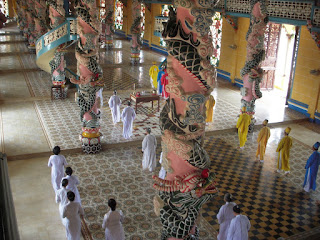
In 1926, a new religion based upon the fusion of Confucianism, Taoism, Hinduism, native Vietnamese spirits, Christianity, and Islam was founded in Tay Ninh, Vietnam. The Holy See of Caodaism was our first stop of this trip. We made it just in time for the noon services, which included music, song, and meditation. The temple itself was beautiful, with colors and a design reminiscent of many of the Hindu temples I visited in India. Voyagers found the service to be beautiful, one remarking to me that it was, “different than any ceremony I have seen before.”
This sanctuary of peace and tranquility could not have stood in more stark contrast with our next stop, the Cu Chi Tunnels. Originally built by the Viet Cong in their struggle against the French and then later expanded for use against the Americans, the Cu Chi tunnels are a roughly 200-kilometer long network of tunnels running underneath the Cu Chi district outside of HCMC. They provided the Vietnamese fighters with quick escape routes and places to hide that allowed them to almost strike out of thin air and disappear just as quickly. The extensive subterranean system housed kitchens, hospital rooms, and military headquarters, although most fighters did not spend more than 24 hours underground at a time.
Crawling through the tunnels and seeing the remnants of the war, like the Vietnamese booby traps used on American soldiers and the craters left by B-52 bombers, were a sobering reminder to many of the Voyagers of the war that ravaged this country not so long ago. Many Voyagers also chose to visit the War Remnants Museum, which provided a similar experience.

Mekong Delta
My last SAS trip in Vietnam was an excursion to the Mekong Delta. We visited the My Tho area, which is renowned for its many fruit orchards. Voyagers were able to see firsthand how the Vietnamese people in this region live and work, deriving much of their sustenance from the river environment around them. Until the 1500s, the area mostly consisted of marshlands and forests but over time, the Khmer people reclaimed the marshes and built a canal system to support the cultivation of rice, fish, soybeans, maize, peanuts, tobacco, and melons. The Vietnamese annexed the territory from the Khmers in the late 18th century and to this day, it continues to be a major agricultural and fishing region.

Photo #10 by SAS Photographer John Weakley
In my last post, I gave a little bit of the historical background on HCMC, but as I found out firsthand, that really does not do it justice. You truly have to be there to experience it. One
 example of this is the unique experience of crossing the street in Vietnam. In a city where motorbikes only cost between $200-300 USD, to say they are everywhere would be an understatement A lack of traffic signals and a propensity to ignore the few that are there also adds to the excitement of trying to get from one side of the road to the other. After recently snorkeling in Thailand, I likened it to be a lot like trying to make your way through a school of fish with all of them just swarming around you, coming close enough to make you squirm, but in the end just speeding right around you. It was chaotic and constantly moving, but after a day, you began to get a feel for it.
City Orientation

My first trip was the SAS City Orientation. We began with a visit to the Thien Hau Pagoda, a
 traditional Vietnamese temple. Besides the incredible building itself, the main attraction here were the long coils of incense, which can burn for roughly a month. Next was the Reunification Palace, which before 1975 housed the President of South Vietnam. Our other stops included the HCMC post office, the Notre Dame Cathedral of HCMC, and the history museum, which was a favorite. SAS Voyagers were treated to a wonderful display of water puppetry there, which is an ancient Vietnamese tradition.
It dates back to the 11th century when farmers in the northern part of the country created this form of puppetry to entertain one another when their rice fields flooded. They used their own flooded rice paddies and ponds as the stages for these shows. The water puppet performances seen today usually depict rural Vietnamese life. The show that we saw was a wonderful portrayal of river life and farming.
English in Vietnam
The next day, I joined about 15 students on a Faculty-Directed Practica (FDP) under the
 guidance of Professor George Thomas. For those of you who do not know, at least 30% of a student’s grade in every course is comprised of work done in the field. This particular FDP explored the use of English in Vietnam.
I think that a lot of times, many of us take it for granted that wherever we go, there are people who speak English, and in most cases, that is true for just about everyone we encounter. Professor Thomas, a professor in linguistics (for full bio, please click here) teaches three courses on the MV Explorer that trace the origins of language, examines how they have developed and spread throughout the world, and looks at what types of policies are being implemented to reform and modernize languages. One course in particular, English as a Global Language, deals with the question of a need for a global language and then explores why English has fulfilled this role in the world today.
Considering America’s history in Vietnam, one might think that Americans and our language might not be very welcome in the country. However, we all were happy to discover that the Vietnamese people have fully embraced both. The first stop on this FDP was the Ho Chi Minh University of Social Sciences and Humanities. Stephanie Malone, a student of Professor Thomas called it, “the perfect compliment to my world languages course.”
Professor Nguyen Van Hue of the university proclaimed to us that, “the topic of English in Vietnam is terrific one.” He went on to explain how English is being used and taught in the university. It differs from department to department, however, all students are required to pass an English entrance exam before being admitted to the school and in order to graduate, it is necessary to pass a proficiency exam. For those majoring in English, all lectures, presentations, and exams are completely in English. The school even offers English writing and speaking clubs that are cosponsored by the US Consulate.

Why is English so important? As Professor Van Hue explained it, “English is the means to obtaining a job and rising to the top of your field.” Another Professor commented that, “English is the most important language in Vietnam.” Kiersten Boehm, another student of Professor Thomas has been learning about the migrations of languages around the world and saw this FDP as a great way to see the spread of a language in action and to see firsthand the importance and great role that English plays in Vietnamese society.
Cu Chi Tunnels and Cao Dai Temple

In 1926, a new religion based upon the fusion of Confucianism, Taoism, Hinduism, native Vietnamese spirits, Christianity, and Islam was founded in Tay Ninh, Vietnam. The Holy See of Caodaism was our first stop of this trip. We made it just in time for the noon services, which
 included music, song, and meditation. The temple itself was beautiful, with colors and a design reminiscent of many of the Hindu temples I visited in India. Voyagers found the service to be beautiful, one remarking to me that it was, “different than any ceremony I have seen before.”
This sanctuary of peace and tranquility could not have stood in more stark contrast with our next stop, the Cu Chi Tunnels. Originally built by the Viet Cong in their struggle against the French and then later expanded for use against the Americans, the Cu Chi tunnels are a roughly 200-kilometer long network of tunnels running underneath the Cu Chi district outside of HCMC. They provided the Vietnamese fighters with quick escape routes and places to hide that allowed them to almost strike out of
 thin air and disappear just as quickly. The extensive subterranean system housed kitchens, hospital rooms, and military headquarters, although most fighters did not spend more than 24 hours underground at a time.
Crawling through the tunnels and seeing the remnants of the war, like the Vietnamese booby traps used on American soldiers and the craters left by B-52 bombers, were a sobering reminder to many of the Voyagers of the war that ravaged this country not so long ago. Many Voyagers also chose to visit the War Remnants Museum, which provided a similar experience.

Mekong Delta
My last SAS trip in Vietnam was an excursion to the Mekong Delta. We visited the My Tho area,
 which is renowned for its many fruit orchards. Voyagers were able to see firsthand how the Vietnamese people in this region live and work, deriving much of their sustenance from the river environment around them. Until the 1500s, the area mostly consisted of marshlands and forests but over time, the Khmer people reclaimed the marshes and built a canal system to support the cultivation of rice, fish, soybeans, maize, peanuts, tobacco, and melons. The Vietnamese annexed the territory from the Khmers in the late 18th century and to this day, it continues to be a major agricultural and fishing region.
Photo #10 by SAS Photographer John Weakley
Saturday, March 21, 2009
Welcome to Vietnam!

 It’s just past 8:00am here in Vietnam and the MV Explorer is now docked in port after snaking its way through the Nha Be River on the last leg of our passage to Ho Chi Minh City. A number of Voyagers awoke before the sun was even up to watch as we made our way through the beautiful Vietnamese landscape.
 There is an incredibly deep and vibrant history here. Ho Chi Minh city, formerly known as Saigon, is today the largest city in Vietnam. It was originally established as a small fishing village named Prey Nokor and was inhabited by the Khmer people before the Vietnamese began to settle in the area. In the 1600’s, the Vietnamese annexed the territory from Cambodia. However, it was conquered by the French in 1859. They formally renamed the city Saigon and made it the capital of their colony, Cochinchina.
The French influences on the city can still be seen today and it is often referred to as “The Pearl of the Far East” or “The Paris in the Orient.” Saigon once again became a capital city following the split between the north and the south, serving as the capital of South Vietnam from 1954-1975. Following reunification though, the capital moved to Hanoi, located about 1,000 miles north of Saigon, and the city was officially renamed Ho Chi Minh City. However, even to this day, the city is still commonly referred to as Saigon, even on signs located in Hanoi.

What was once a swampland is now home to roughly 9 million inhabitants and has become arguably Vietnam’s most important city. While it only accounts for 0.6% of the country’s land area, Ho Chi Minh City boasts 7.5% of the population, over 20% of the nation’s GDP, and close to 30% of industrial output. The standard of living is also steadily rising, with per capita income rising from $730 USD in 2006 to $2100 USD in 2007. Ho Chi Minh City is also home to over 70 colleges and universities, which together have a student population of roughly 380,000.
Semester at Sea voyagers will also be making their way to several other destinations in Vietnam as well as Cambodia. I will be posting some stories on the trips in the coming days so stay tuned!
Friday, March 20, 2009
Halfway There
The MV Explorer has been quite a busy place lately, and things are only going to pick up from here. We departed Thailand last night and we will arrive in Ho Chi Minh City, formerly known as Saigon, early Sunday morning. It’s a virtual whirlwind through Asia that will also include Hong Kong, Shanghai, Kobe, and Yokohama.
Voyagers are taking full advantage of every stop though. Thailand provided all of us with a plethora of opportunities for exploration and travel. The most popular destinations included Bangkok, Phuket, Chang Mai, and Pattaya. From visiting orphanages, to riding elephants, to petting tigers, to learning about Thai history and Buddhism, and visiting incredible temples and palaces, Semester at Sea students really did it all.
We recently passed the halfway mark of our journey together, and for many students, the voyage is really starting to take form. We have reached a point where real comparisons of a number of countries and cultures can be made and the intrinsic unique value of the Semester at Sea mission becomes more and more evident. Charlie House, a student in international affairs at Marshall University, said that, “before I left, my friends told me that things would change...in Bangkok they did.”
The human contact that Voyagers are having, the poverty they are witnessing in certain places, and the cultures they are experiencing, in addition to an academic program that is truly global, is having a marked impact on Voyagers’ respective views of the world. Greg, a student at the University of Maryland, works in an ER back home, and in Bangkok, he joined UVa med students that are on board for a few ports on a visit to a major hospital. He described his experience to the community. “I was looking around, seeing patients and doctors interacting in the atmosphere…it was so different there – the language and the faces – but it was the same also…the same human experiences I see at home. Things are different, cultures clash, but I see so much of the same, everyone wants the same things in life no matter where they are. Things are remarkably similar in their different ways.”
The education students are receiving also hits closer to home though, and many Voyagers are finding out that they are learning more about themselves through this journey. SAS trips are taking many outside of their comfort zones and into unfamiliar territory. As Emily Cohen, a Babson University student, said, “It’s good to push yourself to places you don’t know.
Voyagers are taking full advantage of every stop though. Thailand provided all of us with a plethora of opportunities for exploration and travel. The most popular destinations included Bangkok, Phuket, Chang Mai, and Pattaya. From visiting orphanages, to riding elephants, to petting tigers, to learning about Thai history and Buddhism, and visiting incredible temples and palaces, Semester at Sea students really did it all.
We recently passed the halfway mark of our journey together, and for many students, the voyage is really starting to take form. We have reached a point where real comparisons of a number of countries and cultures can be made and the intrinsic unique value of the Semester at Sea mission becomes more and more evident. Charlie House, a student in international affairs at Marshall University, said that, “before I left, my friends told me that things would change...in Bangkok they did.”
The human contact that Voyagers are having, the poverty they are witnessing in certain places, and the cultures they are experiencing, in addition to an academic program that is truly global, is having a marked impact on Voyagers’ respective views of the world. Greg, a student at the University of Maryland, works in an ER back home, and in Bangkok, he joined UVa med students that are on board for a few ports on a visit to a major hospital. He described his experience to the community. “I was looking around, seeing patients and doctors interacting in the atmosphere…it was so different there – the language and the faces – but it was the same also…the same human experiences I see at home. Things are different, cultures clash, but I see so much of the same, everyone wants the same things in life no matter where they are. Things are remarkably similar in their different ways.”
The education students are receiving also hits closer to home though, and many Voyagers are finding out that they are learning more about themselves through this journey. SAS trips are taking many outside of their comfort zones and into unfamiliar territory. As Emily Cohen, a Babson University student, said, “It’s good to push yourself to places you don’t know.
Saturday, March 14, 2009
Rock On, MICE!
 Yesterday afternoon, the Mobile Interactive Computer Ensemble (MICE) made the most of our brief stop in Singapore and arranged an international concert with students at the National University of Singapore. Dubbed “an international drive-by concert” by MICE’s director, Professor Matthew Burtner, the performance took place while we were anchored and being refueled off of the coast of Singapore.
The performance, which was broadcast through Singapore by the National University of Singapore’s radio station, NUS Radio Pulze, was comprised of four pieces. Before the show began though, Professor Burtner introduced listeners to MICE’s unique style of music and all of us in the Union got to say hello to our counterparts at the National University. Matthew described the performance to the audience as “sound-art pieces that explain the natural environment around us and human interaction with it in new ways.”

First up was Kañja, which had been recorded while the MV Explorer was sailing across the Indian Ocean from East Africa to India. Next was an ensemble for percussion, saxaphone, and computers entitled That which is bodiless is reflected in bodies. The third MICE piece was Sandprints, which MICE performers recorded during our visit to Namibia.
 The grand finale was Singapore Beacon, which was specifically designed for this visit. The technology was initially developed by a UVa grad class under Professor Burtner’s direction and was adapted by MICE for this performance. Anyone who was able to download the software created by MICE before the show was able to participate. It basically worked like a computer game. When Matthew gave us the signal, we started the program, which transformed our laptops into instruments and us into musicians. Our computers emitted a beep, or beacon, which we controlled through the MICE program. As we adjusted the tone and pulse, the sound changed and we could explore different pitches and rhythms as we wanted. It was a great experience and thoroughly enjoyed by everyone!
Thursday, March 12, 2009
Literature Around the World
Another course aboard the MV Explorer that takes advantage of our unique journey is Professor John Serio’s International Short Stories class. Professor Serio (full bio) is a specialist in modern American poetry and a full professor of Humanities at Clarkson University. He has been the recipient of several NEH grants as well as two Fulbrights, one to Greece and one to Belgium. He is returning to the ship after his first voyage during the Spring 2005 semester.
By reading, discussing, and comparing short stories from around the world, his students are learning about history and culture through a literary lens. The stories often provide a great introduction to the culture and history of the countries we will be sailing to. I read the assigned stories before we arrived in Chennai and I completely agree with Serio’s students. The short stories introduced me to the Indian caste system and tradition of arranged marriages and served as great complements to the pre-port briefings.
Perri Prigoff, a student at Boston University and one of Professor Serio’s students, told me that the stories in class “have introduced us to India and lesser known aspects of some ports’ cultures.” She continued to say that the stories “provide further insight into what we don’t normally see… they show us something more.” When I asked Perri what she felt set this course apart from a similar class offered back at home, she responded, “At home, you’re so far removed from what you’re studying that it doesn’t hit home and it doesn’t seem like its real.” On the ship, students had the opportunity to learn about the caste system and the cultural and social norms of India, and then step into the streets of Chennai, Delhi, and other places and see for themselves how their class studies portrayed real life.
A visit to a port represented in a story can also reinforce what was discussed in class and many times will add new perspectives. Professor Serio told me that his class intertwines different literary elements with discussions of analysis of cultural norms, traditions, and religion, which are an important aspect of revealing the themes of the stories. The class also reflects lessons learned in global studies and other courses because of the necessary background to understand the various settings of the stories. While you can learn the literary aspects of these stories anywhere, there really is no comparison to seeing for yourself what the various authors are discussing and trying to capture in their work.
By reading, discussing, and comparing short stories from around the world, his students are learning about history and culture through a literary lens. The stories often provide a great introduction to the culture and history of the countries we will be sailing to. I read the assigned stories before we arrived in Chennai and I completely agree with Serio’s students. The short stories introduced me to the Indian caste system and tradition of arranged marriages and served as great complements to the pre-port briefings.
Perri Prigoff, a student at Boston University and one of Professor Serio’s students, told me that the stories in class “have introduced us to India and lesser known aspects of some ports’ cultures.” She continued to say that the stories “provide further insight into what we don’t normally see… they show us something more.” When I asked Perri what she felt set this course apart from a similar class offered back at home, she responded, “At home, you’re so far removed from what you’re studying that it doesn’t hit home and it doesn’t seem like its real.” On the ship, students had the opportunity to learn about the caste system and the cultural and social norms of India, and then step into the streets of Chennai, Delhi, and other places and see for themselves how their class studies portrayed real life.
A visit to a port represented in a story can also reinforce what was discussed in class and many times will add new perspectives. Professor Serio told me that his class intertwines different literary elements with discussions of analysis of cultural norms, traditions, and religion, which are an important aspect of revealing the themes of the stories. The class also reflects lessons learned in global studies and other courses because of the necessary background to understand the various settings of the stories. While you can learn the literary aspects of these stories anywhere, there really is no comparison to seeing for yourself what the various authors are discussing and trying to capture in their work.
Subscribe to:
Posts (Atom)


 Posts
Posts

